| Section 15
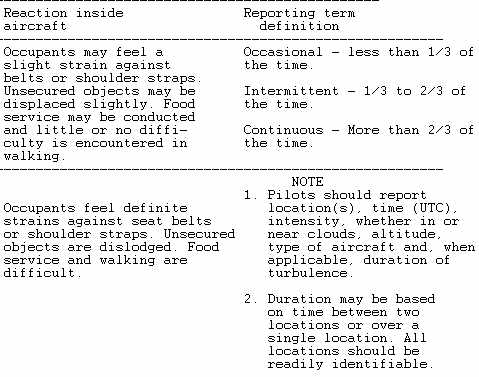
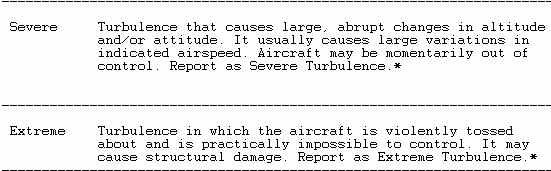
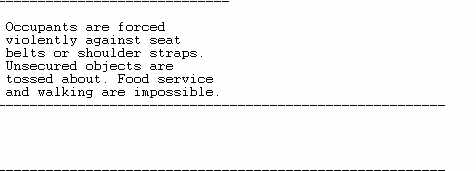
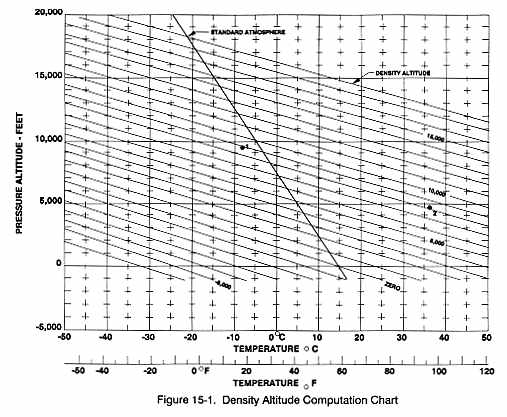
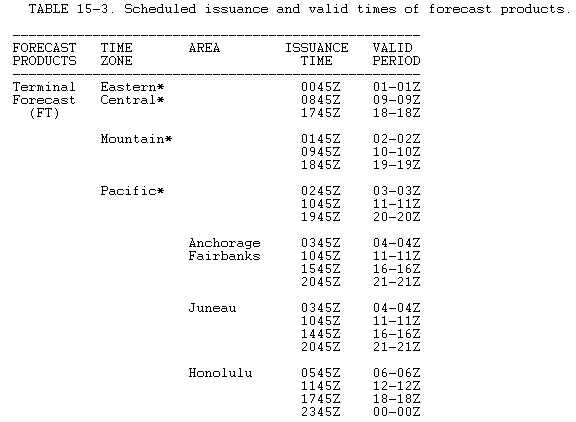
TABLES AND CONVERSION GRAPHS This section provides graphs and tables that can be used operationally in decoding weather messages during preflight and inflight planning and in transmitting pilot reports. Information included covers: 1. Icing intensities and reporting. The table of Icing Intensities (Table 15-1) classifies each intensity according to its operational effects on aircraft. The table of Turbulence Intensities (Table 15-2) classifies each intensity according to its effects on aircraft control and structural integrity and on articles and occupants within the aircraft. The section on Locations of Probable Turbulence lists each turbulence intensity along with terrain and weather features conducive to turbulence of that intensity. The graph for Density Altitude Computations (see Figure 15-1) provides a means of computing density altitude, either on the ground or aloft, using the aircraft altimeter and outside air temperature. Contractions are used extensively in surface, radar, and pilot reports and in forecasts. Most of them are known from common usage or can be deciphered phonetically. The list of Selected Contractions contains only those most likely to give you difficulty. Acronyms used in this manual are defined in the list of Acronyms. The table of Scheduled Issuance and Valid Times of Forecast Products (Table 15-3) lists forecast products, and their issuance times and valid periods. LOCATIONS OF PROBABLE TURBULENCE BY INTENSITIES AS IT RELATES TO WEATHER AND TERRAIN FEATURES Light Turbulence 1. In hilly and mountainous areas, even with light winds. a. Troughs aloft. 5. In the lower 5,000 feet of the atmosphere: a. When winds are near 15 knots. Moderate Turbulence 1. In mountainous areas with a wind component of 25 to 50 knots perpendicular to and near the level of the ridge: a. At all levels from the surface to 5,000 feet above the tropopause with preference for altitudes: (1) Within 5,000 feet of the ridge level. b. Extending downstream from the lee of the ridge for 150 to 300 miles. 2. In and near thunderstorms in the dissipating stage. a. When surface winds are 30 knots or more. c. Where there is an invasion of very cold air. 5. In fronts aloft. a. Vertical wind shears exceed 6 knots per 1,000 feet, and/or Severe Turbulence 1. In mountainous areas with a wind component exceeding 50 knots perpendicular to and near the level of the ridge: a. In 5,000 foot layers: (1) At and below the ridge level in rotor clouds or rotor action. b. Extending downstream from the lee of the ridge for 50 to 150 miles. 2. In and near growing and mature thunderstorms. a. Vertical wind shear exceeds 10 knots per 1,000 feet, and Extreme Turbulence 1. In mountain wave situations, in and below the level of well-developed
rotor clouds. Sometime it extends to the ground. a. Large hailstones (diameter 3/4 inch or greater) DENSITY ALTITUDE COMPUTATIONS Use the graph, Figure 15-1, to find density altitude either on the ground or aloft. Set the aircraft's altimeter at 29.92 inches, it now indicates pressure altitude. Read the outside air temperature. Enter the graph at the pressure altitude and move horizontally to the temperature. Read the density altitude from the sloping lines. For example: (1) Density altitude in flight. Pressure altitude is 9,500 feet and the temperature is -8 degrees C. Find 9,500 feet on the left of the graph and move to -8 degrees C. Density altitude is 9,000 feet. (2) Density altitude for take-off. Pressure altitude is 4,950 feet and the temperature is 97 degrees F. Enter the graph at 4,950 feet and move across to 97 degrees F. Density altitude is 8,200 feet. Note that in the warm air, density altitude is considerably higher than pressure altitude. ICING INTENSITIES TABLE 15-1. Icing intensities, airframe ice TURBULENCE INTENSITIES TABLE 15-2. Turbulence reporting criteria
|